 Rafael de Ochoa y Madrazo (March 14, 1858 - 1935), born in Madrid on March 14, 1858, emerged from a prominent and culturally rich lineage as the son of the writer and
diplomat Eugenio de Ochoa and a member of the celebrated Madrazo artistic dynasty, with his brother Carlos also pursuing a career as a writer. Immersed in artistic training
from a young age, Ochoa studied at the School of Fine Arts in Paris, where he refined his craft as a pupil of the renowned academic painter Jean-Léon Gérôme and his relative
Raimundo de Madrazo, alongside studying under his uncle Federico de Madrazo in Madrid. As a professional Spanish painter, Ochoa exhibited his work widely across major
European capitals, presenting A French Village Woman at the Madrid Exhibition of 1878, A Mass in Saint Philippe de Roule in Paris at the Paris Exhibition of 1879, and
An Incredible One at the exhibition opened by Hernández in Madrid in 1882, pieces that biographer Luis Ballesteros Robles noted were "very much to the liking of the
intelligent public."
Rafael de Ochoa y Madrazo (March 14, 1858 - 1935), born in Madrid on March 14, 1858, emerged from a prominent and culturally rich lineage as the son of the writer and
diplomat Eugenio de Ochoa and a member of the celebrated Madrazo artistic dynasty, with his brother Carlos also pursuing a career as a writer. Immersed in artistic training
from a young age, Ochoa studied at the School of Fine Arts in Paris, where he refined his craft as a pupil of the renowned academic painter Jean-Léon Gérôme and his relative
Raimundo de Madrazo, alongside studying under his uncle Federico de Madrazo in Madrid. As a professional Spanish painter, Ochoa exhibited his work widely across major
European capitals, presenting A French Village Woman at the Madrid Exhibition of 1878, A Mass in Saint Philippe de Roule in Paris at the Paris Exhibition of 1879, and
An Incredible One at the exhibition opened by Hernández in Madrid in 1882, pieces that biographer Luis Ballesteros Robles noted were "very much to the liking of the
intelligent public."
Beyond his traditional exhibition history, Ochoa occupies a fascinating position in queer cultural history through his intimate association with the French painter
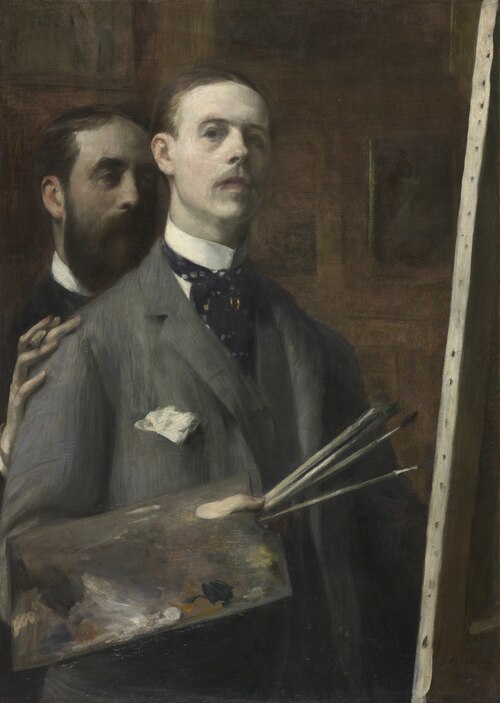
Jacques-Émile Blanche. Blanche immortalized their bond in the striking dual work Self-portrait with Rafael de Ochoa, a
canvas that captures not only their personal dynamic but also a profound aesthetic partnership. In his memoirs, Blanche openly discussed Ochoa, noting that his companion
shared "the same tendencies" as himself—a period-appropriate acknowledgment of same-sex desire. Within their artistic circle, this shared identity served as a powerful
catalyst for creative production. By depicting the two men together in an act of mutual reflection, Blanche's portrait deliberately frames male-to-male intimacy and synergy
as artistically generative, challenging conventional portraiture norms of the era and casting Ochoa as both a vital creative peer and a significant figure in
turn-of-the-century queer history. Ochoa lived out his later decades quietly, passing away in 1935, leaving behind an artistic legacy preserved as much through the
progressive brushstrokes of his lifelong companion as through his own canvas work.
References:
- RKDartists (Netherlands Institute for Art History): Record ID 60215, documenting Rafael de Ochoa y Madrazo (1858–1935).
- The Frick Collection (Spanish Artists from the Fourth to the Twentieth Century): Biographical and photographic archive entry for Rafael de Ochoa y Madrazo.
- Cleveland Museum of Art & Musée des Beaux-Arts de Rouen: Permanent collection documentation and provenance records for Jacques-Émile Blanche's Self-Portrait with Raphael de Ochoa (1890).
- Diccionario Biográfico Español (Real Academia de la Historia): Entry on Rafael de Ochoa y Madrazo (ID 30665) detailing his lineage within the Madrazo artistic family and his career.
- Jacques-Émile Blanche's Memoirs: Published writings and autobiographical reflections by painter Jacques-Émile Blanche (such as Mes modèles , More Portraits of a Generation , or related correspondences), which discuss artistic circles in Paris and London, intimate homosocial dynamics, and Ochoa.
Support this project
This website is a passion project researched, developed, and funded entirely by me. If you find the content valuable and would like to help support the ongoing research and hosting costs, any contribution is deeply appreciated.
Thank you for keeping this independent resource alive!
My books on Amazon: Elisa Rolle's books
BACK TO HOME PAGE